
Indigenous Conservation in Fiji: A Language Beyond Words
Soukaina Rabii
Across Fiji’s lush islands, conservation is experienced rather than simply observed. Through the textures of the soil, the scent of the ocean, the rhythms of the wind and the changing colours of the landscape, Indigenous communities read nature’s subtle language. Rooted in ancestral knowledge and sensory intuition, this essay explores how the five senses shape a profound relationship with the living world, reminding us that protecting the Earth begins with learning to listen to it.
The Memory of Touch
“The body is a haptic archive of memories inscribed on the skin”, I am reminded, as my phalanges coincidentally unearth from a drawer seashells I once picked with my hands beneath Fiji’s radiant sun.
I am stood in my London flat, beneath the skydome ceiling window where a slate-heavy sky seeps in, dimming the room with the city’s familiar grey. Yet, touch holds the mnemonic power to reactivate buried souvenirs from a thousand submerged lives ago.
Island treasures enclosing secrets; hazy visions of past sailing adventures. Time folds in on itself and I am reborn into the moment. Echoes of distant scenes thread through me, lodged under the epidermis, details re-awoken with vivacious clarity.
The rugged textures of fossils beneath my feet; incandescent sand grains cradling my toes. Crystalline waters – ambient and silken – caressing my ankles; iodine-soaked hair drying in the equatorial breeze, cardboard-stiff against my neck.
In Indigenous Fijian culture, touch is knowledge.
The land is read through the soles of bare feet. Soil firmness registers moisture content, signaling stress or saturation. “Feeling the ground tells farmers when to conserve and wait, or when abundance permits fields to be planted more widely without exhausting the land”, rises a voice to my left.
Ruci, a Fijian mother-of-three and my hospitable hostess, lets her gaze roam over a half hectare swath of cassava right of her family’s modest piloti house — a traditional over-water bure perched on frailing stilts at the edge of Waya Lailai, where the ocean settles into a pristine lagoon.
A tuberous root vegetable, cassava ranks as the most cultivated and consumed staple in Fiji – nearly one-third of total annual volume harvested. Ruci credits this partly to the crop’s remarkable endurance to erratic climate conditions. By virtue of its robust phenotypic properties and abiotically tolerant microstructure, cassava grows effortlessly in any soil.
Yet, the village keeper insists “none of this plenty would come to fruition” – quite literally — “if not for our farmers’ versatile care and intuitive qualities”. She gestures further, “living organisms can only thrive under adaptive stewardship; spirits channel sensory acumen to nudge us towards abundance.”
Accordingly, palpable indicators determine when to delay planting during drought or heat conditions, or expand cultivation and rotating crops during periods of prosperity. “Tending of the land must not be forced”, Ruci cautions, “we surrender body-awareness to the will of the elements – their agency cannot be resisted”.
The tribechief, seasoned by decades of lived experience, grounds her claim in demonstration: Ruci plucks a cassava from a tilled mound, barely glancing as she reaches for it. From her satisfied expression, I deduce the oddly-shaped specimen in her hand is precisely what she was scouting for. The putrid stench alone clearly marks it as inedible.
“Cassava is delightful in that it can be eaten in a variety of traditional preparations, while its starchy roots may be set aside and kept to ferment into alcohol”. Ruci is referring to Fiji’s infamous “chewed beer”, derived from cassava’s fibrous composition and naturally occurring salivary enzymes. Skimming the vegetable’s knobby surface with her fingers, Rudi issues a swift caveat: “Yet, the more tapered the texture, the higher the levels of toxic cyanogenic glycosides—a sign of ill land.”
Touch, a vigilant sentinel of the body, has long served as a survival tool through evolution, alerting humans to poisonous substances before ingestion. Like Medusa, tactility foretells ruin before harm can strike.
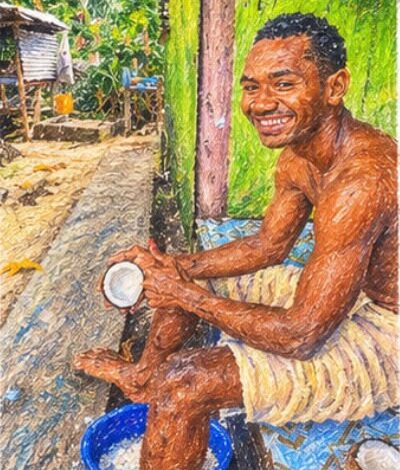
Joshua, Ruci’s eldest and only son, chimes in to playfully temper Ruci’s noceboism. His sinewy hands, calloused by years of tenuous practice, contour the perimeter of a humungous, smoother cassava as he proudly underscores the flawlessly upright cylindrical form of his homegrown legumes. The Tagane –Fiji idiom for adolescent– notes these physiognomic features reveal a crop safe for consumption, teeming with bioactive compounds typically repurposed as organic fertilizer to stimulate beneficial microbial activity.
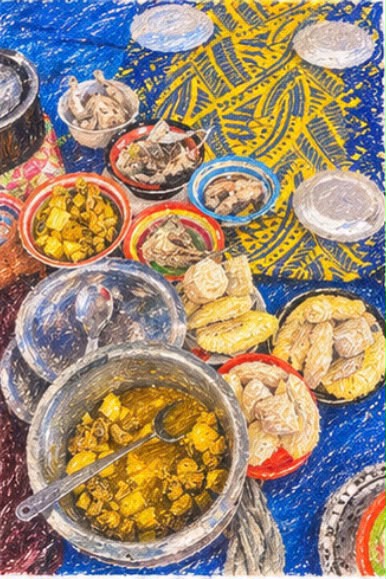
“Evidence of ecologically fit cassava lies in satiny texture and palmately-lobed leaves”, reflects the juvenile. His furrowed face softens into a smile of fulfillment, of labor well-honed — the fruit of generations of attunement to the soil’s manifold tactile cues. Later that evening, I would be fortunate to sample freshly boiled cassava alongside Joshua’s hand-speared reef rabbitfish. Ruci’s words proved true—the root bends with equal grace to sweet and savoury, a gustative testament to the plant’s Houdini-esque adaptive genius.

Ruci then drifts left, hovering towards a rudimentary yet astute water-pumping setup.
Rainfall is trickling down through what appears —at first contact—to be a volcanic rock filter, collecting water in an artesian aquifer. According to the matriarch, the island’s endemic silicate minerals—coarse-grained, interlocking crystals—lend Fiji’s famous bottled water its silken mouthfeel. “The older the volcanic sequence of the rock, the more enriched the geochemical profile”, ascertains the storied naturalist.
To guide filtration-grade rock selection, Ruci correlates the “high heat retention in a volcanic stone” to “accumulated shifts in solar radiation” over millennia. A featherlight stroke to gauge a stone’s temperature suffices to discern the passing of time: the warmer the rock’s “thermal memory,” the greater the probability it harbors remnants of ancient arcs forged during the Miocene-Pliocene.
In Viti Levu, Ruci’s locality and one of the tiniest principautés in the Fijian archipelago, dacite and andesite geodes are particularly coveted for their filtration properties. Rough and pronouncedly exothermic at palpation, their dense layer acts as a resilient sheath sequestering minerals. A vestige of the Pacific Plate’s subduction beneath the Indian-Australian tecton —whereby pressure, heat, and fluid thermodynamics concentrated mineral assemblage.
An idiosyncratic trait of the islands’ geological lithology, gemstone-mediated hydraulic sieving has evolved into a lucrative enterprise for the Fijian government. Average annual exports of volcanic water approach $281M, making Fiji the world’s 4th-largest exporter among 196 countries. Although, scrutiny persists around the ecological and ethical costs of transporting plastic bottles from a remote provenance, including “the scant benefits trickling down to communities”, Joshua specifies.
With a fingertip, Ruci teases out another Earth’s hidden truth: the colder the aquifer, the purer its essence. “Chill slows the dance of bacteria and chemical reactions, yielding fresh water”, particularly when paired with century-aged, metabolite-dense rock filtration.
Josua further jokes that in Fiji, touch is a vernacular : how you tell whether a coconut has ripened into something worth savoring, or whether a palm frond is stout enough to become a broom. He admits he has yet to match his mother’s “fervent connection” to the power of touch, yet is grateful for the spiritual entrainement she inculcated in him.
Tongue-in-cheek, the neophyte fisherman quips that “learning to read a fish’s scaled skin spares him from spoil flesh”: tightly anchored scales with springy resistance signal a freshly caught fish; while soft, loosening scales that smear under the fingers indicate cellular breakdown. “We fish and dive for nearly everything we eat”, further expounding on the cultural reliance on touch as a steadfast guide to subsistence. Yet, the reef serves not only as a subsistence larder but as an economic mainstay, its harvests underpinning income and livelihoods. « Economic exigencies must be calibrated against the reef’s capacity for ecological replenishment ».
Touch is also particularly valuable in construction vigilance on an island prone to natural disasters, where architecture must be designed to deflect high winds, withstand storm surges, adapt to rising waters, and endure seismic shifts.
The self-tutored landscaper, wrought by years of direct entanglement with climatic calamities, describes the yavu, the foundation of the house: an elevated mound of earth, clay, or stone, which she regularly palpates for signs of erosion and moisture ingress that may compromise the structure’s stability. The heavy local hardwoods, such as vesi, that bear the frame and posts also require inspection for rot, insect damage, and structural fatigue, while the floors of packed earth or clay must be checked for excessive softening or uneven settling beneath their woven coconut-leaf mats, as these may indicate dampness.
Conservation in Fiji is not abstract. It is tangible, bodily—a living contract with the land. Land assessment relies on somatosensory sensibilities whereby inconspicuous variations —felt through touch rather than measured— inform seasonal adaptation and agricultural decision-making, with critical implications for food security in enclaves as insular Wayasewa.
Ruci ponders, contemplating the disaggregating erodible in her palms, an unsettling horseman of climatic unravelling. For Fijians, touch is as much a proactive practice of “action and prevention”, as it is a sensory conduit.
“The surface of elements resembles human skin—sensitive to contact, revealing the planet’s vitality”. Nurtured, it yields softly, offering its bounties. Neglected or battered, it hardens and roughens. A reminder of our duty to steward the land with reverence and a delicate touch.
The Air Remembers
Memory coils tighter in the seashells as their gastropod exoskeletons press into my palms— their story extends past touch, carried now in the marine effluvium of the ocean.
Some argue it is scent that anchors nostalgia most powerfully.
I spiral from the white-sage incense of my London flat into a tropical vortex. Salt hangs thick in the air, mingling with the tang of damp earth and desiccated algae, titillating my nasal receptors. I am yanked back to a souvenir, standing at the water’s edge.
The Koro sea scintillates in a myriad of hues —iridescent blues, emerald greens, molten golds. Its colors shift subtly modulated by ionic variations: paler refractions emerge when aqueous pH is balanced, exhaling the petrichor vellum of nutrient-rich upwellings; while darker tones are accompanied by the pungent smell of putrescent kelp and decaying phyloplankton.
The submerged frontier of the Pacific, in all its kaleidoscopic oscillations, further journeys to the edge of Waialailai’s valley. The deeper the voyage into Poseidon’s abyss, the more venal the olfactory gradient: a brine-suffused bouquet that signals the fecundity of Life subaqueously, but also alerts to the lurking menace of sharks in the depths. Trimethylamine—the distinctive ammoniacal musk released from the secretions of apex predators—a waft instinctively shunts back rare wayfaring surfers or devilish bathscapists who dare to probe the chummy thalassic stretches of the Pacific-Indo.
At long last, the valley –or buca— unfolds before me. Veiled in mist, faintly etched on the horizon, it rises in skyward defiance: a tapestry of lush greenery and volcanic rock, a colossus arising from antediluvian fires. Tempestuous tides crash against its sidewalls, pressing ozone-laced gusts into the stone, and imprinting a chlorophyll‑washed perfume along the canyon’s flanks.
For Indigenous wardens, aroma operates as a barometric alarm — an alchemical compass to chart ecological thresholds and inform conservation and self-preservation.
The halinity of the ocean; the saccharin elixir of a fruit or rot of vegetation; the metallic hint of rain on stone; the amine-rich volatiles emanating from calcareous husks —each functions as a cornucopic repository of ecological data.
For root vegetable farmers like Ruci, a sulfurous or sour odor rising from waterlogged soils warns of anaerobic conditions—oxygen deprivation—suggesting heightened risk of rot.
Any acrid discharge of the sort prompts careful drainage adjustments: channels are cut deeper to reintroduce oxygen, in hopes of avoiding the arduous necessity of moving plantings upslope—a task both time-intensive and physically laborious. “If drainage does not recover,” Ruci sighs, “we postpone planting.”
Ruci’s flagship produce—cassava and dalo—exhibit a particularly high propensity for necrobiosis, with starch-rich tubers creating microenvironments that favor microbial proliferation. I catch a fetoric miasma from a discarded dalo, heaped in a pile awaiting burning. The effusions from putrefaction extrude a noxious trail akin to that of a macerated carcass.
To disregard odoriferous warnings—to unheed Tellus, our Terranean progenitrix—amounts to “imperiling the circuitry of nature and harvest integrity”. As per the tale of Gaia marshalling a scorpion to undo Orion for boasting he could slay every creature on Earth, human hubris beckons divine punishment.
Joshua takes a metered whiff of the conch carapaces he has been sampling for calcification monitoring—a protocol to detect early indicators of ocean acidification—before unfurling on alternative modalities and auxiliary ways that odorant biomarkers prove indispensable.
“Rancid exudates detected in the air near planting allotments indicate saltwater intrusion”, the savvy youngling postulates. “It typically mandates delineating cultivars to shield growing zones and basins from saline encroachment”. Thus unfolds a calibrated choreography of bunding, walling, and vegetative buffering to engineer hydrological insulation:
Earthen levees –raised ridges of compacted soil– are built around taro paddies to prevent seawater from flooding in. Squat walls constructed from local pebbles or coral fragments, reinforced with coconut trunks or bamboo, act as semi-permeable barriers against tidal incursions. Concomitantly, thick-knit tillage such as pandanus or Vetiver grass along rivulets actively modulate infiltration while stabilizing sediment run-offs.
Further deciphering the language of malodorant chemosensors, Ruci’s husband Mali lifts a receptacle of granular mud deposits from the riverbed. Pointing to the container of fluvial detritus, the chieftain explicates how friable sediment slurry–which often releases an accentuated pestilence akin to rotten-egg or burnt-match smell– betrays a fraught substrate–to-fluid interface vulnerable to percolation.
By the same hydraulic logics that govern fluxes on land, vertical seepage through porous coastal matrices begets suspicions of compromised skeletal integrity in coral reefs. “As the ocean acidifies and slips into corrosivity —sponges, worms and microbes wither, while calcium lattice loosen due to thermal bleaching”, intonates the headman. These predicamentious contingencies necessitate bolstering littoral carbon sinks to revitalise coral reefs against dissolution, and should that fail, fortifying mangrove belts serves as the ultimate frontline bulwark against sea-level ascent and the sediment migration and cyclonic surges that follow.
“The shoreline is the system’s first-line defense; only once it is secured can inland cultivation be worried about”.
With the perspicacity of a modern-day merman, Joshua further sibilates that “any change in the smell of reef waters—especially brackish— further alerts locals to O₂-voracious algal blooms or coral stress”. Such odor-guided diagnoses may trigger imperative reef closures to reduce fishing pressure, with adverse repercussions for food security and livelihoods dependent upon reef-derived income.
“As a cardinal rule, freshwater scents or loam-smelling terrain presage safe floodplain cultivation”, Mali stipulates with the authority of a matai. Geosmin, a chemical effluent produced by actinomycetes soil bacteria, denotes potent microbial communities and decomposition of organic matter without anaerobic stress. “It’s symptomatic of moisture equilibrium and healthy nutrient content”.
These olfactive cues are pivotal in orienting Indigenous Fijians to infer optimal agrosystems, sustainable fishing practices, and coastal-terrestrial protection.
“Mother Earth’s multitudinous fragrances and plumes constitute more than just indicators of biomineral health and microhabitat structuring”, Ruci injects, “it has primed our perceptual acuity to recognise when to activate preemptive measures to ensure resilience against changing climates before critical thresholds are crossed”.
Ruci pauses, emotion catching in her throat. The clan matron, her bearing weathered by tenacity, speaks of guilt—of not pressing harder for relocation efforts when the seaways had warned them.
“The storm’s electrical charges had split atmospheric nitrogen and oxygen, recombining them into reeking ozone and sweeping it from higher altitudes to ground level”. A stratosphere laden with combustible-halogens, driven down by gale-force winds—these apocalyptic monitions should have foreshadowed the deluge. Tropical Cyclone Kina struck in 1993, unleashing torrential rains that displaced more than 120,000 people and wiped out generations of ancestral land.
“The losses rippled through our lineage—we remain indebted and have yet to regain ownership of our home”, murmurs Ruci. A stark harbinger of how natural cataclysms entrench poverty, in an island nation tethered to foreign microcredit across areas ranging from food assistance to infrastructure provision—a fiscal dependency that perpetuates neocolonial economics.
For Fiji’s Indigenous custodians across 300-plus islands, smell-mediated intuition steers them “towards tuning into either plenitude or restraint”. To proceed against Terra Mater’s airborne poisonous omens would be to defy its sovereignty, and sacred intentionality. “Depending on the Sky’s exhale, odor portends either Uranus’ wrath or his blessing, ” concludes Mali.
The Shape of Silence
The coquilles balancing on my knuckles shimmer with diaphanous translucence, their rattling synchronising with the periodicities of the pallid heliacal luminance sluicing through the zenithal aperture in my South London workroom.
The sound evokes the ethereal refrain of gleaming fish leaping in unison beneath the sea’s undulating surface. Their tale-flap motions generate faint pressure soundwaves akin to percussive clicks.
Bioacoustic signatures of natural behaviour, revealed through vibration.
A seal’s high-frequency screeching—cortisol—triggered by the steadied hydrodynamic pulsing—adrenaline—of an approaching shark. The basse-octave chorus of a school of damselfish during peak feeding periods—formed by rapid fin flicks. A reliable proxy for abundance, their stridulatory resonance emerges only when food density is sufficient enough to support relaxed, energy-expensive emissions and broadcast ecological surplus to their peers through sound. Come, the feeding is plenty.
There is something profound in this convergence of sound and behaviour: in Fiji, musicality becomes instruction.
Waves speak first, their cadence shifting with the moon’s centripetal sway. Wind follows, threading through palms and valleys, bending, muffling or amplifying sounds, carrying distant bird calls and unseen rain.
“Elders listen for subtle phonic changes”, Ruci enunciates. Reefs growing quieter, forests losing voices, breezescapes arriving too early or too late. All bear discernible traces of a perturbed biospheric milieu.
Ostending to the quiescence of the trophic enshrouding us, Joshua further propounds that declining soundscapes—marked by diminished snapping shrimp and attenuated fish vocalizations—emblematize coral degradation. “We are obliged to alternate episodic fisheries closures or temporary bans”—a recovery intervention vital to safeguarding species viability and biodiversity resilience.
He sussurates of the days when the catch of smelt –each fish a bolt of silver-blue not much longer than a ballpoint pen— was so profuse they would punch through the mesh and pop up behind the fishing crew’s aluminum punt with a bad-tempered gasp of vitality. “That cry of vigor—it isn’t there anymore.”
Joshua directs me towards the desiccated remains of a pelagic marauder beneath the elevated familial tipi, amid a legion of finned cartilaginous lifeforms littered ashore along the waterline. Low oxygen, harmful algal blooms, sudden temperature changes, disease, salinity anomalies, storms and cyclones, ocean acidification, commercial fishing, the mercurial unpredictability of indocile currents and imponderable tides — all bear responsibility.
The novice angler avows his commitment to balancing the trade-off of income pursuit and alimentary self-reliance against long-term ecological prerogatives. As his predecessors attest, it was non-contemporaneous moeurs that “enabled our people to navigate decennia of nature’s tribulations and man-made wars of exploitation”.
There are innumerable more verities foretold in Fiji’s collapsing auditory mosaic. The absence of specific ecotunes further bespeaks forest fragmentation or moisture stress,” Mali continues, preshadowing a tropical dystopia sonically inert and ecologically muted.
The disappearance of key avian choristers captures this —ironically—resounding silence: The extinction of island thrush—melodious phrases delivered at dawn and dusk—is a telemeter of growingly deciduous forests inapt for nesting and foraging. The retreat of black-capped chickadees and the fading of their two-tone fee-bee whistles from logged and suburbanized habitats betoken depleted insect prey availability and altered microclimates. Another indictment of biorecession—the Yellow Warbler’s staccato lilt vanishing from riparian zones, indexing wetland loss, hydrological disruption, and increased predation pressure.
Ruci, whose upbringing within an autochthonous yavusa made her a seasoned hand in land work, further affirms that fluctuations in the whispers of the wind may be operationalised to revise cultivar calendars. When stiff drying gusts rustle through croplands, farmers sow hardy seedlings early to exploit the arid window before heavier moisture returns; when humid languid airstreams linger, they delay germination until soils become more favourable. “Plants tolerate drier windage, while excessively wet ventilatory flows can encourage fungal disease, alongside rot, waterlogging, or poor establishment”.
“We even realign coastal travel in response to changing seasonal aero-currents,” supputates Joshua, showcasing the crucial value they extirpate daily from being fluent in nature’s sensory lexicon.
When the breeze is benevolent, the island hums—punctuated by the roaring engine of impish taxi boats waltzing with the tides as they ferry sun-dazed tourists and surf-heavy crowds to and from the port; the beach itself seems to stage the spectacle.
But when the atmospheric system turns austere—imprevisible, behemoth, ungovernable— the harbor falls into a haunting pall: tourists retreat inland, crossings cease, routine thins to procedural logistics. “Provision boats may arrive from the mainland only once every six weeks,” as if the island were held hostage by a capricious, meteorological deity.
I heed attentively to the histrionic seascape, to glean glimpses of Joshua’s cosmological tales of godhead fury. The concussive thud of supernal waves imploding in daemonic bursts as if hammered by Rokomautu’s iron blow, occasionally interrupted by the infrasonic moan of the Zephyr wind loading the cliffs as its shrill shears across fractured stalactites, monolithic slabs, flint shards, and jagged ridgelines.
These aqueous detonations—pluviatic, aeolian, or marine—are the island’s own lullaby, composed by its people and habitats. “It is the bulldozers and cargos we despise,” utters Joshua, referring to the invasion of tourist eco-luxury lodgings along the Yasawaw chain: construction dins, amplified music, the growl of machinery, and the soniferous comings and goings of mining ships dredging seabeds for mining aggregate, replacing innate phonological topography.
“An unbearably loud void”, Joshua laments the oxymoronic tragedy of human-engineered post-industrial regimes. Sonorously vacant, stripped of its acoustic understory, yet deafening in the torrent of synthetic instruments overwhelming our nervous wirings, inducing relentless technogenic exacerbation.
As if to offset the daunting materiality of Joshua’s doomsday prophecies, Mali leavens the mood with the kind of optimism borne of elder cognizance.
He stares at a murmuration of petrels sketching balletic arcs against the setting vesperal skies. “Helios is uncommonly bright at this hour, I cannot help but smile, and in turn, the sun returns the offrande.”
With the ceremoniousness of a cosmocrator, he discourses upon how sound is not just a portent of bad news– “it started as a medium of expression”.
Oral traditions—songs, chants, fables—encode ecological history, transmitting intrinsic knowledge from one vessel to the next. “The inheritance chain extends infinitely across bloodlines and temporal strata.”
“I can distinguish my children from afar; the deferential humility in their voices, and solemn manner they speak of their peers and Mother Nature, represents our DNA in motion. Each day, their spirit saddles the body as a horse mounts the road—with deference and reverence for the land and its living kins. My hope is that each time they tread the Earth, they summon the familiarity of those who came before them: I hear it in the subdued chug of the tractor as Joshua decelerates to spare a flower, in the deliberately tempered scrape of stones as Miri exhumes them, or or in the gentle crackle of vutu boughs as Ruci returns them after taking only enough to fashion a bed. Their existence consecrates an injunction to resist the presentist tyranny of cynicism and defeatism—to remember the dulcet trill of a congregation of newborn nectarlings, not the lugubrious spectre of cyclone drills and tornado sirens.”
Ruci interjects, with the sagacity of a motherhen, emphasizing that “wisdom—through oral lore—is, first and foremost, prudence against catastrophe.”. To illustrate her hyperbole, she proffers a generous invitation to a church gathering. I sit at the back of an open-air chapel, beneath garlands of tropical foliage, scouring Ruci’s prized Bible, its ornate cover embossed with the words ai vola—“book”—and taru— the village denomination. Inside, a meticulously itemised genealogical tree of my gracious host family.
Within Fiji’s Christian majority, educational storytelling manifests through hymns and sermons—a comprehensive instructive curriculum in which Homeric peripeteia of natural calamities are woven into Biblical chronicles. With lyrical dexterity, folkloric semantics and sonorities coalesce into fabular mythos.
Pastors recount past chimeresque hazards during lotu—gospel congregations—their inflections and intonations growing eerie as they describe unforgiving tempests in acoustically evocative allegories. The convulsive aerophony of the west winds descending upon the village, as though a warning to shepherd resettlement from tumultuous shorewards. The guttural rasp of native fauna in the presence of looming danger, mimicked with minute precision by the preacher-orator, his staccato assuming the timbre of the hunted under the watch of its pursuer.
In a country where nearly half of children do not complete upper secondary education, “worship narration prevails as an efficacious pedagogical recourse for preparing incumbents,” Ruci exegeses. Through listening—to land, to water, to one another—Fijian communities sustain Indigenous savoir-faire and artisanry, honouring continuity over extraction. The environment is not conquered but conversed with, and through that dialogue, communion becomes an act of preservation.
Miri, the youngest daughter, is a peculiar contre-pied to the archetype of Fiji’s hereditary guardians. While her elder Joshua, a nursling already embodying the physicality and sure-footed gait of a traditional fisherman, has taken up the vocation of his forebears, Miri, on the cusp of fifteen, favours a more epicurean mode of “cohabitation with the world”. For her, sound—music above all—is inseparable from fun: not merely a means of apprehending abundance, kinship, survival or sustenance—but an indissociable accompaniment to emotional, spiritual, and communal pleasure.
“Conservation need not be a life of sacrifice and hardship; it can be art, drama, dance, photography, as well as lots of fun games.”
We sit outside her “room,” a tin nook shared with six other relatives. Dépêche Mode—the English electronic rock band from Basildon—spills its dark, synth-laden harmonics into the afternoon, followed by the grunge distortion of Seattle’s own Alice in Chains and Nirvana, as the convivial household prepares to ring in Miri’s birthday. The beauty of globalisation: borders rendered little more than divisive human constructs. I introduce her to France Gall’s Besoin d’amour, a bright chanson of longing, and Cheb Khaled’s Aïcha, an Algerian rai classic of love. Ruci hears only what she dubs “bang-bang” cacophony, yet, half-reluctant and half-proud, busies herself hanging the birthday banner and readies cassava buns.
Miri affixates similarities between punk and heavy-metal subcultures and the hand-banging gospels of lotu, “both rally around anti-capitalist attitudes and values”. The polyglot connoisseur plays a cassette recording, a vudu genre that mixes meke rhythms with mainstream “western” productions. It’s tinged with the same nihilism as garage and acid rock—with the swagger of disco and sultry blues of jazz and the upbeat, syncopated grooves of island pop. “Musicians are all about reciprocity; we are just responding to the tucked-away isolation of our musty surroundings”, she opines jestingly. Whether in a graffiti-scrawled Washington basement or a Fijian girl’s den, alive with birthday ribbons, band flyers and amp cables, youth speaks the same sonance: anti-establishment, countercultural, defiantly its own.
Perhaps born of her teenage insouciance, the nascent rebellion of individuation against the stricture of parental authority, and an avid curiosity for the confluence of foreign contrées and multidisciplinary interests, Miri rebuts alarmist climate discourse—“they are detrital and facetious”. The musicophile muses buoyantly on biophony—the living soundscape of a habitat—which has long informed human language, music, and instruments; she would rather “cherish that legacy than dwell on the miseries of colonial dispossession”, the holistician retorts.
Her stance is not one of indifference; rather, she contests the illusory prospect of being heard by “Western bureaucracy.” Profit-hungry corporations, ostensibly “Samaritan” charities, each invested in the optics of benevolence—“they manufacture the semblance of democracy, distracting us with referendums whose outcomes are foreordained. We exhaust the soul in the ritual of sadness and anger. I prefer to dedicate our brief allotment of time on this ephemeral speck of dust to attending to its beauty”.
She subsequently ventures, “Had our Earth not collided by sheer happenstance with a comet four billion years ago—that improbable astral accident that fertilized Life itself—none of us would be here. An extraordinary series of serendipitous events had to happen—for us to find ourselves here now, articulating our deepest ponderings, making ourselves understood to one another. That is what sound signifies: the air in the lungs set in motion, allowing the vocal cords to give breath to thought.”
I acquiesce in agreement. What are the odds of a burnt-out London techie from the northernmost hinges of Africa, that Mediterranean–Atlantic jut, beneath the Pillars of Hercules, and a descendant of the Lapita voyagers who first disembarked on the heart-shaped Mamanuca Islands some 800 years ago, trading favourite albums? I grab an archaic, weighty laptop and download a dubious MP3 clip of U2’s Beautiful Day and The Flaming Lips’ Flight Test—a window into the campy soundtrack of Smallville, a comic-book series that defined my childhood. She exclaims: “Their outfits rock.”
Through chronologies, from genesis to the neoteric anthropogenous order we revere as “modern society”, mankind has evolved within the intricate symphony of the living world. Home to chorusing frogs and insects, and marquee bird species known for their singular calls, nature’s orchestra finds its analogue in everyday parlance and vocabulary: “buzz,” the drone of humblebees, “chirp,” the clipped utterances of birds. It finds its ways in quotidian rhythmics, from tribal dances to scripture recitations, highlighting a back-and-forth between organic and artificial acoustic creations.
Perennial messenger of curse or benediction, sound is not merely tribute to the entangled continuum between subsistence, livelihood, people and the fauna and flora we partage our environment; it operates fundamentally as a monument to the traditions, customs, and praxis of oral narration for knowledge exchange, now being lost to industrialisation and extinction. To articulate, disseminate and enliven constitutive know-how through a rite as elementary as the elation of breath.
Bioacoustics—the study of sound in living systems—and ethnomusicology—the study of music in its cultural contexts—invite us to contemplate the role of sonority in configuring our world, and how, in turn, we give it form. “Do not underestimate human agency; it’s long had its part in taming the elements,” parries the budding dau ni vucu. “It is a misreading to cast nature as vengeful providence or inscrutable sovereign supplicating submission; nature is unconditional grace, it exacts no terms, only enjoining Adam’s progeny to create meaning.”
Miri’s commentary conjures a piece I once wrote, how the inevitability of our mortal condition colours the meanings we impute, particularly the act of naming—a seemingly unassuming deed yet one of considerable weight. Somebody, somewhere, before the alphabet, before full language, looked at their child, then at the fire, the sun, or some astonishing hibiscus efflorescing they had never noticed the world could make, and felt the same feeling twice. That’s got to be where it started: someone standing in the dark, pointing at their child, then the moonlight, because both stirred the same unnamed feeling. Before words, there were only sounds made in fear, gratitude, or awe; somewhere in that primordial vocalisation, someone reckoned a sound could belong to a person—a grunt could be a name. That was the first act of magic: deciding a sound could hold meaning.
The rest of the evening is blissfully squandered indulging in reggae fusion, a hybrid that integrates rock-and-roll arrangements with bright iTaukei choral traditions and themes of indigenous pride. The ensemble incorporates a palimpsest of ustensils—ukuleles, guitars, steel pans, and localised percussion, including wooden log drums.
“We must step into a new conception of our ecosystem as a spatialised soundscape,” declares Miri, “sapiens inhabit not merely material space, but a rich polyphony— each voice at once infinitesimal and indispensable. Sinner or saint, we love, cry, and laugh in the same vibrato.”
The Language of Light
I palpate the molluscan reliquaries resting on my walnut-smoked writing desk, their nacreous surfaces caught now in the evanescent alpenglow of the waning English day.
There are sputtered remnants of a drying inkwell beside a stack of handwritten letters. Black, the colour of midnight, charred timber, and the deepest ocean trenches —the gravity of what is concealed, or left unsaid. White, by contrast—salt flats beneath an unforgiving sun, the bleached bones of ancient landscapes, or the immaculately of an untouched page, before Ruci affered herself to scribbling down on her field notebook, entrusting her carnet d’observations with ponderations meant for no other witness.
The fragile archaeology of human thought: words once fluid, fixed in pigment, bearing trace to the curious impermanence of things. I can almost see her patibular gait, standing amid the jostling throng, on a tropical spring afternoon, the nib of her fountain pen recording her musings with the devotion of a scribe charged with chronicling the final hours of the Earth.
That day, Rudi spends the better part of an hour examining the vibrant plumage of a parrotfinch perched on the buttressed roots of a mature vesi tree, heavy with waxy white blossoms. The self-taught endemist is dissecting the chromatic composition of its robe —“the neon feathers of the collared lory signal fruiting seasons” she asserts, with the infallible certitude of a practice learned by repetition.
The field-trained autodidact then turns to survey the golden sheen of a Fijian monarch butterfly’s wings. She jolts tonalities and gradations on a piece of parchemin—emerald correlates to abundant access to bountiful nectar; ruby flashes vitality as saturated red pigments reflect efflorescent blood flow and metabolic health; while dull yellowish huescences adumbrate suboptimal nutrition when floral resources are limited. “Studying papilionaceous creatures helps us evaluate pollination cycles,” Ruci explains, and therefore “elucidate salient indices pertaining to food security and balanced ecologies.”
For Fijians, seeing is not mere observation, rather an analytical interface of their surroundings. Visuals layered with ecological signatures, all imbued with information, each holding a readable imprint of our biocenosis.
The deep green of Pandanus tectorius, a fixture of Fiji’s botanica, besignal soil fertility. When its flowers shoot scarlet, it confirms adequate rainfall, encouraging nectar production. These ocular tracers regulate agricultural timing such as planting taro, “which must coincide with peak vibrancy of local inflorescences, ensuring pollinator cues are optimal”.
Changes in leaf chromaticity, from vigorous to muted or blotched, evince indicia of nutrient depletion and hydric strain, demanding crop rotation or fallow periods —a method whereby land is deliberately left unplanted to restore fertility and curb pest and disease pressure. “It preserves the resilience of arable soils in the future, while sustaining current productivity under aleatory climatic conditions.”
Ruci trods towards an arborescent sapling. She further enounces insider tips exhaustively catalogued in the opus of visual phenotypes she has documented over the years — “the fiery orange of Hibiscus tiliaceus, another tropica ubiquitous to Fiji, announces the onset of the wet season”.
Likewise, Mali breaks down how elders decipher permutations in reef palette in order to establish coastal health: paling toward white, or algae intensifying to oxidised-verdigris, telltales thermal stress and nutrient runoff, ushering fishing restrictions. The customary Vula ni Tabu. Tabu or Tambo— to institute temporary or permanent fishing interdictions across local coral grounds (qoliqoli), allowing fish stocks to replenish and the attendant reef biota to recuperate. Vula– promulgated by fish wardens and village councils when decreeing the opening or closure of specific fishing seasons.
Further, colour may predict coastal resilience to inundation. “Muddier wetlands are pathognomonic of diminished mangrove vitality along the coast,” flutters Ruci. Browning rivers after rain, for instance, designate sediment erosion from cleared hillsides, proscribing reinforcement of agroforestry buffers to mitigate surface runoff and downstream flood risk.
By interrogating chromatic variegations as a proxy for how rising sea levels and storm events mobilise sand and water, Fijians can design seawalls, rehabilitate wetlands, and erigate dunes in targeted locations to absorb wave energy, forestall flooding, and inoculate infrastructure and ecosystems along the coast.
Even the ocean’s evershifting pelage, from aquamarine over coral flats to penetral indigo in innermost channels, dictates navigational routes. The sinister the gradient of the marine stratum, “sailors must vector attention towards potential brooding maelstroms”, Joshua exhorts sternly. Once deceived by the seducing siren of a prosperous turquoise expanse, « what looked like an effulgent school of azure fusiliers, morphed into turbulent cyanotic-tinted subterranean vents that nearly suck us into the abyss, » chides the fledgling aquanaut.
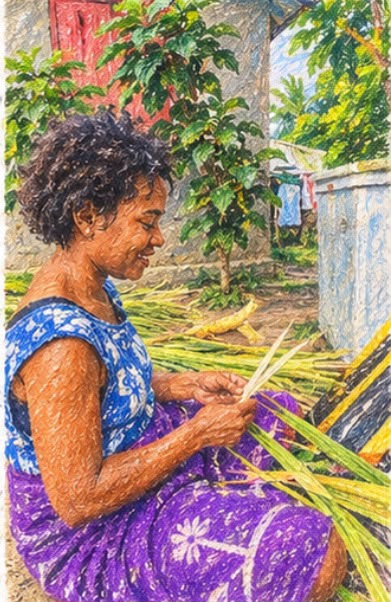
With the countenance of the presider of a hearth, Ruci instructs us to tack up an artefact against the house’s sunward overture, where the equatorial light falls most perniciously: a finely plaited vegetal matwork of vau and pandanus leaves — chlorophyllous green, straw-gold and the russet-brown of sun-cured fibre.
The artisan showcases dozens of similar pieces laboriously coaxed into form by hand: window curtains and sun shades embroidered with authentic Fijian masi (tapa cloth) patterns. “The items mirror geometric art inspired by Fiji’s landscape, and colour constellations from ancestral cosmology and knowledge of the heavens”. The home décor panels bring traditional island aesthetics to indoor spaces, while serving a practical function by using insulated laminate organics to block UV rays and lower interior heat. She unspools the quantum sorcery behind the curio heirlooms, “it is the meeting of sun-reflective pigments and the shapes of the motifs that bends and scatters the light”.
Mangrove bark lends the cloth its earthen brown, dissipating the sun’s glare; candlenut soot deepens it to light-swallowing black; while red ochre burns through the weave, its thickset chromophores trapping incoming solar radiation, tempering the rays before they enter the house. Motifs–concentric bands and microlinears striations– further refract the passing light at changing angles, the periodic intervals between the ornamental configurations refracting, or diffracting its path.
Ruci’s ingenuous plaitwork of form and hue contrasts the windows against the tenebrous umber of their timber casement, whose “close-grained texture and resine-patinated surface indicate ironclad structural soundness”, Ruci teaches me.
Using the same repertoire of visual clues, Fijian cabins rise with chromatically attuned roofs, layered from plant material — straw, reeds, ferns and rushes, coconut palm and sugar cane leaves, soga palm or local grass tied together. The straighter stems make up the most resilient and load-bearing layers, while strands with fulgent color formulation indicate freshness and flexibility. The whole tessellates into a waterproof, insulating cover praised for its rustic beauty and natural temperature regulation. Similarly, walls consist of interlaced bamboo, their electric-viridian shade synonym of air-permeability, while the slender culms arranged in chevroned and lozenge geometries channel cross-ventilation, allowing oppressive air currents to escape and cooler draughts to infiltrate.
“The trick is to braid as tight as your metacarpals allow”, recondites a fellow compatriote of Ruci’s, occupied with fastening and stringing magi magi: in lieu of modern nails or metal bolts, the structural uprights are lashed together with stout husk-fibre cord or sinnet, each tie tautly cinched to make the dwelling hold as one. An inspection of the magi magi frapping confirms whether the structures interlock tightly, shed water efficiently and guarantee long-term durability.
In keeping with traditional building practices, “tonal lustre, natural shape, fibre orientation and geometric layout decide material selection and placement”. Each component is carefully chosen for its lines and color —visual hallmarks of strength and durability— ensuring architecture will endure.
Maintenance is a watchful craft too: the evolving pigments and patterning across constructions predicate the structural mettle beneath. Even the subtlest chromatic departure betokens where the cabin holds firm or begins to weaken. The bamboo transmuting from verdoyant to honeyed ochre due to seasonal insolation “is Vanua’s intimation that the latticework is due for renewal”, Mali bequeaths.
The roof shudders with the winding turbines Mali wrought by hand from ferrous metal– “the burnished aspectus of the metal sheen connotes uncompromising strength,” divulges the turaga-ni-koro— while the rest of the palm-frond batisse fluoresce beneath the receding sunlight.
For Fijians, visuals function as a diagnostic tool. It plays a role in constructing a sensory-generative conception of the surrounding environment. In this way, the interplay between light and color serves as an elemental, yet infallible optical apparatus for mapping ecological health.
Beyond furnishing practical climate-adaptation measures,” Ruci sanctions, “colour exceeds logistics”—it operates as a grammar of tones, hues, and forms through which incipient generations inherit primeval traditions. “We descend from a lineage of potters, whose material memory reflects the upheaval of colonial indenture–our artisanship enshrines visual codes of rupture, displacement, and survival”.
I spend the rest of the evening making traditional Fijian sasa brooms, handcrafted from the dried midribs of coconut palms. Makers gather fallen fronds, strip away the foliage, and sort the rigid spines (sasa) by length before bundling them into a tight cylinder or flat fan. The bundle is secured at the base with traditional hand-braided magi magi. Beyond their practical household purpose, these eco-friendly brooms provide a source of community income and serve as ceremonial offerings, including at the welcoming of a child to their mother’s ancestral village — Kau ni Mata ni Gone.
During my stay, I also try my hand at traditional Fijian jewellery, crafted from shells, seeds, coconut, beads, and other locally-sourced natural materials. Makers combine colour, form, scale, repetition, and symmetry to concoct balanced, meaningful adornments. “Contrasting colours distinguish individual elements, while repeated beads, shells, or seeds establish rhythm,” explains Ruci. Lastly, forms and material combinations reflect distinct styles and cultural contexts, contributing to the overall visual identity of the piece.
Miri unbosoms further tidbits of indigenous arcana. The precocious apprentice apprises me that a butterfly’s wing is in actuality transparent; what the eye reads as colour is elicited by photons encountering microscopic scales, where interference redirects the energy of light into shifting wavelengths. Perception is illusion, she impresses upon me, as though a metaphor that imagination may illuminate a truth originelle or distort history itself. “Our habiliments, ingenieurie and constructions form a time-defying patchwork of inherited meanings. It’s immutable to fascist dishonesties”.
In Fiji, Miri’s ethos is enlisted to contribute to harmony, to make the visible world a vessel for reconciliation, rather than let disparate histories exploit differences.
The first stirrings of the universe were written in the chroma of nebulas, » finishes Ruci, her accoutrement, a inherited artistry of her family’s Fijian masi-making lineage, brushing against my chair. Her pen glints between ink-stained fingers as she stoops once more over her itinerant’s journal, lingering in the margins to coax the universe’s oldest mysteries into ink.
The perennial traveller in me stirs; reaching for my own voyageur’s ledger, I begin to sketch Wailei Lei’s luxuriant contours beneath the westering sun, one of many visual mementoes that would come to fill my weather-beaten leather folio of wandering.
Conclusion
As I delect in the copious lovo, a Fijian stone-oven feast Ruci’s kins whipped up for us, I ruminate on the occidental impulse to find structure and order in an otherwise haphazardly chaotic universe. In the midst of our so-called “modern society”’s fascination with pattern recognition, taxonomic classification, the demarcation of identities and the partitioning of the human condition, the social geometry of belonging or excluding, and rigid architecture of sequencing and systematisation, we forgot that nature’s synchronicity is no more than spontaneous coincidences that cannot be casually linked or adequately comprehended by scientific rationality alone.
My erudite hosts have little appetite for explaining things. They would rather marvel at the revelation that we inhabit a world where octopuses dream; otters have a favorite shell they carry with them all their lives; cows keep best friends, and bees speak different dialects of dance depending on the region. Cats purr at a frequency that accelerates bone healing; the forest grows flowers first after a fire, and dolphins bestow each other names and respond to them. Penguins propose to each other by offering one another the most beautiful pebble.
Since Time first learned to count its hours, indigenous teachers have been investigating the ever-elusive human experience and its movement through time and space, centering the body as a “mere visitor” on Earth.
Their findings present the notion that the body is merely an instrument tuned into its environment: light, touch, sound and scent — all can be attributed meaning or a ‘“code”. Across humanity’s incalculable detours and meanderings, discoveries and explorations, across the passage of civilizations, the rise and demise of empires, the recrudescence and loss of coutumes and moeurs, one thing persists as near-universal: intuition. This is one way Fijians reflect upon the ways we might endeavour to better make sense of our natural or man-made surroundings, and our place within it.
Ages beyond the reckoning of men, prior to the abrogation of science and mathematics, psychology, and philosophy into the disciplines the human estate would later recognise; before the ensemble of biology, neuroscience, anthropology, and musicology; and predating the formal study of haptics, olfaction, audtion and visue: Fijians eriged perception at the heart of climate conservation efforts. Transfiguring beyond cartesian science— “modern choreographed environments” and “western ideas of space” — indigenous wisdom privileges the dynamic reciprocity between body and our species’ sense of wonder and capacity for tacit apprehension. Through time, we, the domesticated apes, have been able to instinctually deduct inherent repetitions and patterns of locomotion.
Not unlike a computationally programmed, rule-based engine, Fijians endlessly conjoin and reassemble concrete formations and abstract sequences, producing compositions that orchestrate the cross-modal entanglement between colour blocking, depth of field, and auditory and tactile stimuli. Light becomes an instrument of chromatic bioindication; sound articulates the acoustic frequencies of the living; touch registers textural and thermal cues, while smell apprehends the chemical signatures. Their synesthetic interplay yields both harmony and discord, revealing ecological vitality or degradation– a dynamic environmental scoring system where any shift vaticinates the state of the living landscape.
These sensory relationships shape sustainable practices across the breadth of Fiji’s varied, and majestic landscape—from steep slopes, radial valleys to volcanic corrugations. The comprehensive approach has translated into measurable reductions in coastal and riverbank erosion risk of up to 90%, including curbing sedimentation, flood risk and damage to coral reefs from downstream washing. Inversely, 70 % of surveyed private land managed through non-indigenous management paradigms reported increased erosion-related incidents.
Through the inherited wisdom of the Land’s first stewards – Ruci’s communities noticed further ameliorations region-wide. “Our techniques effectively improve soil carbon entrapment and fertility by up to eight to ten times compared with untreated terrains, helping stabilize riverbanks and farmland”. Senses also guide crop selection and water-management strategies under scarcity or surplus conditions.
Previously, adverse geomorphic phenomena drove the loss of over 50 tonnes of soil per hectare each year through run-off, about four times the average for tropical regions. Erosion, specifically, poses the most insidious menace during disastrous climate events, as weak particle cohesion and low structural stability render land highly susceptible to runoff, bank collapse, or infrastructure degradation by agents such as water, wind, or gravity during rainfall or tidal action.
Such improvements, spearheaded by Ruci and her comrades, are welcome: as per a present-day fiscal benchmark, Indigenous practices are estimated to help avert FJ$12.7 to 21.2 million in drought and cyclone-related damage to homes and resorts each year through terrestrial and coastal protection.
In line with Traditional Ecological Knowledge (TEK), Ruci hopes to further integrate local knowledge, refined over generations, into modern management plans for ecosystem resilience that address evolving sustainability prerogatives, and more importantly, galvanize continuous community-led efforts.
Mali explains their aim is humble; to make inexplicable natural phenomena more tangibly manifest: the elasticity of time, the quantum indeterminacy of space, the mathematical elusivity of tides and celestial orbits, and the relationship between the rhythms of the natural realm and human senses. This becomes all the more vital in a world where sensory instincts gradually atrophy, dulled by an increasingly tamed and disconnected existence. “Our animating principles create an integrated experience that conveys ecological information beyond any single dogmatic curriculum”.
The practice reflects time-honoured and demonstrably effective cultural frameworks and symbolic systems that shaped and governed their reality for centuries. “We strive to distill our Traditional Ecological Knowledge (TEK) into documented, serialised literature that pays homage to ancestral studies on kinetic rhythms, spatial relations and the interplay of the interplay of the five senses”, in the hope to give form to useful practical concepts.
However, “nature’s signs remain ineffable forces that can’t quite be measured” flags Ruci with her quintessential numinous awareness, reminding me of the importance of wonder and intuition in an increasingly logified world.


