On the Silver Jubilee of the Ajdir Speech and Under the High Royal Patronage:The Casablanca Amazigh Theatre Festival Launches Memory Preservation Initiative and Advocates for a National Repertoire Center in Morocco
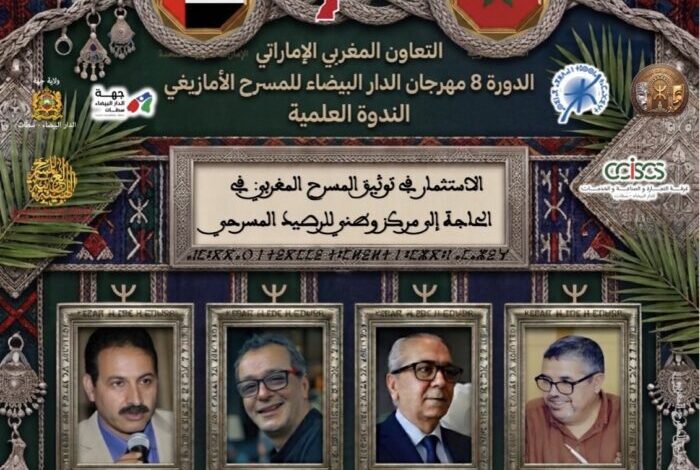
Under the High Patronage of His Majesty King Mohammed VI—may God assist him—and commemorating the silver jubilee of the historic Royal Speech at Ajdir (Khenifra, 2001), the Tafoukt Creative Space is organizing the 8th edition of the Casablanca Amazigh Theatre Festival from September 30 to October 4, 2026. Organized in partnership with the Royal Institute of Amazigh Culture (IRCAM) and the Regional Council of Casablanca-Settat, the festival features a major academic symposium titled: « Investing in the Documentation of Moroccan Theatre: The Need for a National Repertoire Center for Moroccan Theatre. »
Scheduled for Friday, October 2, 2026, at 4:00 PM in the Conference Hall of the Casablanca-Settat Chamber of Commerce, Industry, and Services, the symposium will present the framework for the Encyclopedia of Moroccan Theatre Documentation, forthcoming from the Arab Theatre Authority. Coordinated by Dr. Az-EddineBounit alongside a select group of Moroccan academic, theatrical, and media experts, this encyclopedia includes a dedicated section on documenting Amazigh theatre in Morocco.
Grounded in a concept paper prepared by researcher Dr. Az-EddineBounnit, the symposium proceeds from the scholarly conviction that theatre is distinguished from other arts by its inherently « institutional » nature. Aesthetic achievement in theatre cannot occur in isolation from a supporting structure—ranging from the troupe or venue to the State as the ultimate institution. Historical evidence, from the construction of ancient Greek theatres to the transcription of epics and the founding of drama competitions, confirms that major theatrical evolutions have always stemmed from political decisions and explicit official sponsorship.
Academic and Theatrical Elite at the Core of the Debate
Moderated by Dr. AbdelmajidChakir, Professor of Higher Education and theatre director, the symposium will gather prominent researchers and theatrical figures for in-depth scholarly discussions. Proceedings will open with an examination of the concept paper drafted by Dr. Bounnit, Coordinator of the Moroccan Theatre Documentation Project, which will be distributed to attendees and participants on opening day. Dr. Bounnit emphasizes the inherently institutional character of theatrical art, reiterating that theatre cannot achieve aesthetic fruition apart from an incubator structure spanning from the active troupe to the State.
The panel will also feature contributions from Dr. Ghannam Saber Ghannam (representing the Arab Theatre Authority, playwright, and director) and Dr. MessaoudBouhcine(Professor of Performing Arts and director). Presentations will underscore the imperative of investing in theatre documentation and analyze the contemporary theatrical landscape, highlighting that Moroccan theatrical practice often lacks a permanent anchor to physical space and institutions—rendering performances ephemeral, leading to the continuous loss of archival materials, and eroding creative and aesthetic memory.
Erosion of Memory and the Ephemeral Nature of Practice
In diagnosing the state of the theatre scene, Dr. Bounnit notes that theatrical production naturally generates a vast array of creative documents (scripts, directorial notes, scenography designs, critical reviews) and institutional records (contracts, permits, correspondence). Together, these components constitute the « theatrical repertoire » (الرصيد المسرحي) that forms the bedrock of tradition and feeds future generations.
Two Strategic Goals for Preserving Theatrical Heritage
The concept paper clarifies that the goal of documentation extends beyond writing past history to establishing an ongoing, standardized framework for archiving Moroccan theatre data according to international standards. This vision rests on twostrategicgoals :
- 1. Inventory and Cataloging of Past Heritage: Developing a comprehensive methodology to retrieve documents and data concerning Moroccan theatre history since its origins in the last century, mitigating lost time, and mending gaps in national memory.
- 2. Building a Sustainable Mechanism for a National Center: Laying the groundwork for a National Repertoire Center for Moroccan Theatre. This center will operate in close partnership with Archives du Maroc to leverage its expertise in document standardization, and with the National Library of the Kingdom of Morocco regarding books and manuscripts.
Conceptual Framework: Expanding « Repertoire » and Advocating for the Future
The symposium emphasizes terminological precision, adopting the concept of « theatrical holdings/repertoire » as a broader alternative to the traditional notion of « repertoire. » This holdings concept encompasses not only scripts but all material artifacts and contextual elements surrounding a performance (costumes, scenography, props, administrative records). The paper stresses that documentation is an ongoing process at the heart of information architecture, ensuring accessibility for researchers and integration into international digital indexes.
Consequently, this symposium serves as a scholarly call to action and an advocacy platform for practitioners, critics, and creators to participate in a national project that lays the foundation for a national institution dedicated to preserving theatrical memory and reinforcing the aesthetic traditions of Moroccan theatre in all its facets. It offers researchers, theatre professionals, journalists, and cultural actors an opportunity to engage in public discussion surrounding the implementation of digital and international standards for safeguarding creative heritage.